Best Time to Visit the Philippines: Weather by Month
Discover the truth about the rainy season in the Philippines. What are the best months to visit Palawan or Cebu? Avoid the typhoon season with our local expert advice.
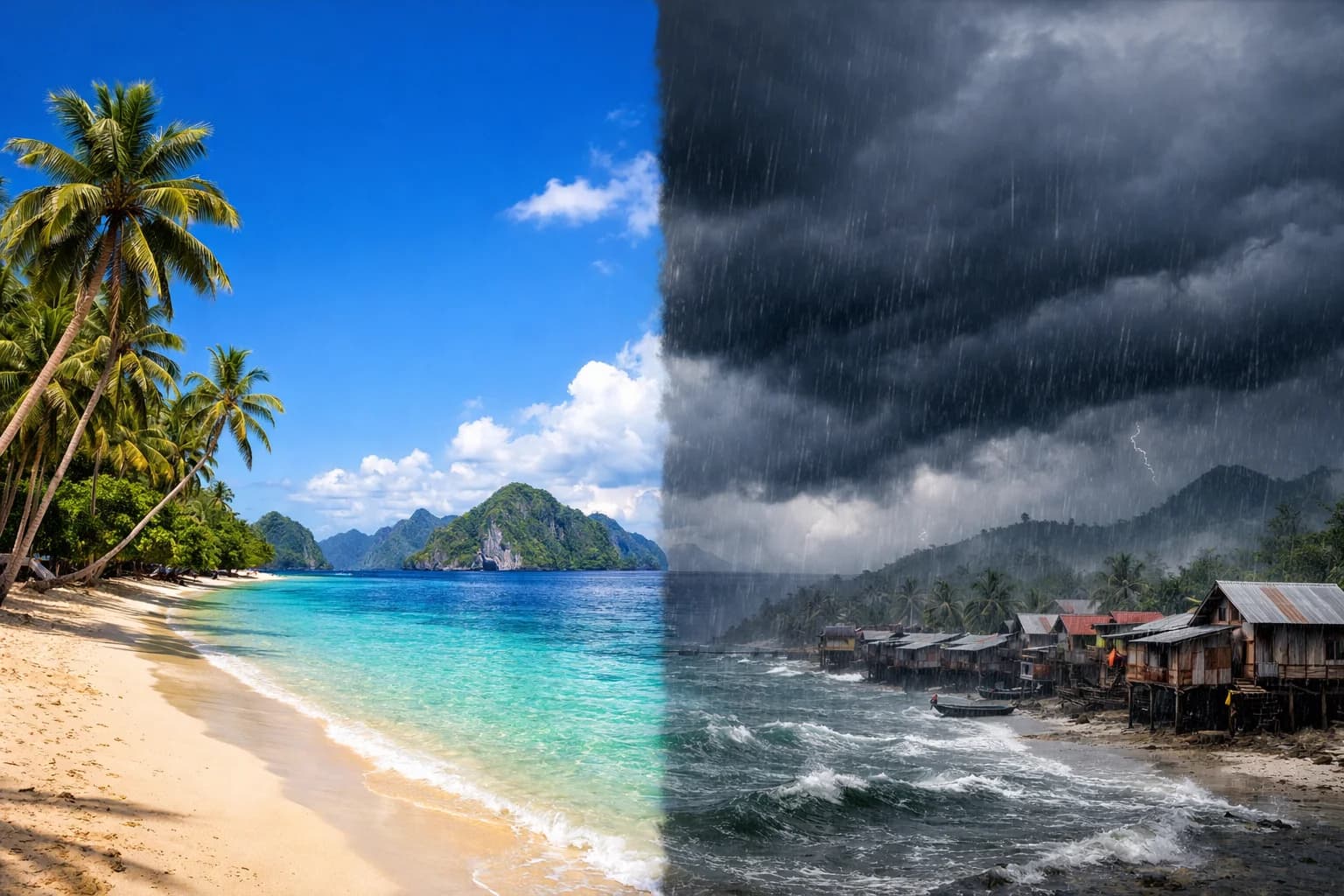
Best Time to Visit the Philippines: Weather by Month
"Can I go to the Philippines in August?" "Should I cancel my trip if the Apple Weather app forecasts rain every day?"
These are questions we receive every week. The short answer is that January to April is the best time for most first trips, while regional weather can make Cebu, Siargao or Palawan suitable at different times. This month-by-month guide explains the trade-offs.
For current conditions, use our live Philippines weather page with regional forecasts, air-quality data and typhoon alerts.
Philippines weather month by month
| Month | Typical conditions | Best for | Main caution |
| --- | --- | --- | --- |
| January-February | Drier, cooler and less humid | Most islands, hiking, city trips | Peak-season prices |
| March-April | Dry, sunny and increasingly hot | Beaches, diving, island hopping | Strong heat around midday |
| May | Hot with first regular showers | Lower crowds, mixed itineraries | Humidity rises |
| June-August | Wetter in western regions | Cebu, Bohol and flexible trips | Ferry and flight disruption |
| September-October | Higher typhoon risk | Trips with flexible dates | Monitor PAGASA advisories |
| November-December | Transition to drier weather | Early high season | East-facing coasts can stay wet |
There are no four seasons in the Philippines. There are officially two, with enormous regional variations between the Eastern coast (Pacific) and the Western coast (South China Sea).
---
1. The Dry Season ("Amihan"): December to May
This is the undisputed peak season for almost the entire country. The monsoons blow from the northeast, bringing relatively drier air (everything remains very humid in the eyes of a Westerner!) and clear skies.
The "Perfect Months" (From January to April)
* The weather: Brilliant blue skies, the sea flat as a mirror, very few typhons. It's the ideal time for island-hopping in Palawan (El Nido, Coron), Boracay, and the Visayas (Cebu, Bohol).
* The temperatures: Between 28°C and 32°C (82°F to 90°F).
* The flip side: It's the very high season. From mid-March to May, the Philippines is on local summer vacation. Beaches and hotels will be crowded, and prices at their highest.
May: The Furnace Month ("Tag-init")
May is the hottest and muggiest month of the year. The thermometer climbs to 35°C (95°F) with a real-feel of 42°C (108°F) in Manila's urban transport.
---
2. The Rainy Season ("Habagat"): June to November
Starting in mid-June, the wind changes direction. The southwest monsoon (Habagat) brings humidity from the Indian Ocean and rich precipitation.
July, August, September: Should you really avoid them?
Contrary to popular belief, "Rainy Season" does not mean it rains 24 hours a day for 3 months.
* How it really rains: Generally, beautiful sunny spells prevail in the morning, and by late afternoon (around 4 PM), an intense tropical deluge falls for one to two hours.
* The geographical exception: SIARGAO. The surfers' island faces the Pacific. From June to September, while it rains on Manila and Palawan, Siargao often enjoys radiant sunshine! If you travel in July-August, focus on Siargao and the Eastern Visayas.
---
3. The Scary Word: Typhoons (Bagyo)
The Philippines experience an average of 20 tropical storms or typhoons per year.
* When? Mainly between late July and November. The absolute peak is September/October.
* Where do they hit? They enter from the East coast (Pacific) and generally sweep through the center (Visayas / Samar / Leyte) or the main island of Luzon (Bicol, Manila).
Are they dangerous? Typhoons disrupt ferries and cancel domestic flights. If PAGASA (the local weather agency) raises a Signal*, coast guards ban all boat departures, even for small tourist excursions. This can block your stay for 4 days in a row.
---
A Local Secret: "Weather Apps"
Never look at your smartphone's default Weather app. In the Philippines, these algorithms see 80% ambient humidity and predict "Rain and Lightning" 365 days a year. If you look at your phone, you will never go to the beach.
* Use the local satellite app or talk to fishermen! If the sky is blue at 8 AM, go out for your excursion.
The unpredictability of the weather is the main reason why we constantly advise you to have a relaxed schedule (at least 3 full days per island) to absorb possible maritime delays due to unforeseen storms!
👉 Consult our platform for [itineraries that take the climate into account](/en/offers)
🌪️ Myths and Realities about Weather in the Philippines
Many travelers are afraid of the rainy season. Here are some myths debunked:
❓ FAQ: Weather and Best Time to Go
What is the water temperature in the Philippines?
The water generally ranges between 27°C and 30°C (80°F - 86°F) year-round. You will never need a thick wetsuit to swim; a simple rash guard is enough to protect you from the sun.
Is it better to book ferries in advance during the typhoon season?
Yes and no. You should know that during a typhoon, the Philippine Coast Guard systematically cancels all boat crossings. Be flexible in your itinerary during the rainy season (July to October).
What to do if it rains every day during my stay?
Plan backup activities: museum visits in Manila, scuba diving (you'll get wet anyway, and the water is warm!), spa treatments, or local massages (hilot). Keep a flexible mindset; tropical weather changes with incredible speed.
Plan and book
Useful services to complete your Philippines trip
Always compare the final price and conditions before booking. These are the steps that most often delay a departure.
Compare flights
Search routes and fares to Manila, Cebu or Clark.
Search flights →Book accommodation
Choose a flexible option and keep proof of your arrival address.
View accommodation →Book activities
Compare tours, visits and experiences in Manila, Cebu and Palawan.
Browse activities →Arrange a transfer
Pre-book a ride between the airport and your accommodation.
Compare transfers →Compare a complete trip
An alternative for comparing flights, hotels and transport in one place.
Open Trip.com →Check travel insurance
Review medical coverage and exclusions before departure.
Get a quote →Install an eSIM
Prepare your mobile connection before landing in the Philippines.
View data plans →Prepare your payments
Compare exchange rates and fees before payments or transfers.
Explore Wise →Prepare onward proof
Verifiable reservation solution when your return itinerary is not fixed.
View solution →