Complete Guide to Manila Terminal 3 (NAIA): Transit and Shuttles
How to survive Manila Airport (NAIA) Terminal 3 in 2026. Where to sleep, find WiFi, eat, and how to take the free shuttle to other terminals.
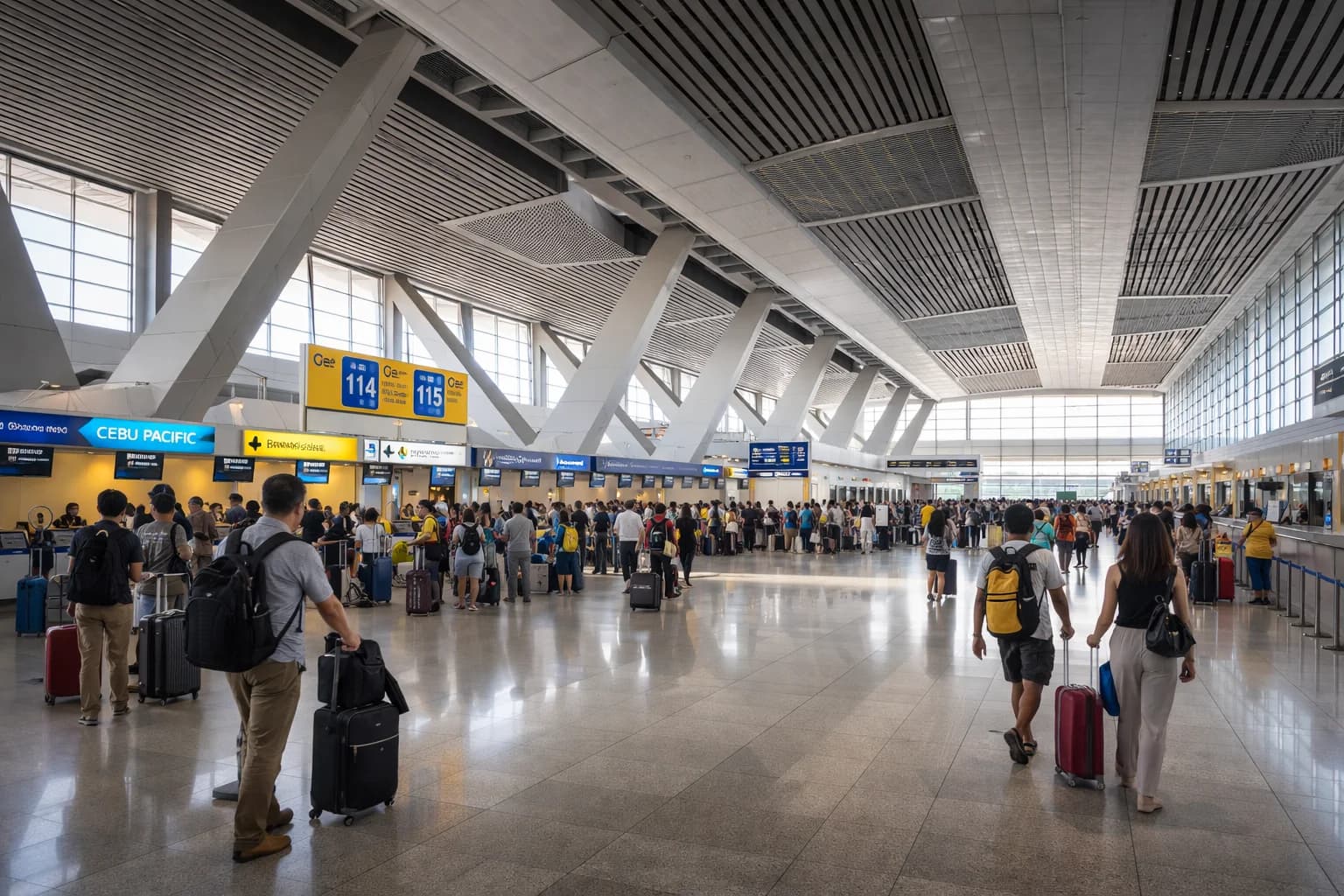
Manila Airport (NAIA) Terminal 3: The 2026 Survival Guide
If you have just landed in the Philippines on an international flight (like Emirates, Qatar Airways, or Delta), there is a 90% chance you are at Ninoy Aquino Airport (NAIA) Terminal 3. This airport trails a chaotic reputation on the internet... but by knowing the right tricks, your transit will go wonderfully!
We use this airport several times a month and have done so for years. No more panic about changing terminals or finding safe drinking water. Here is your ultra-precise roadmap for 2026.
1. You Just Landed: The Crucial Steps
🛂 eTravel Control and Immigration
Even before reaching customs, you will be asked to scan your eTravel QR Code. The airport's free Wi-Fi network (`NAIA_Free_WiFi`) works reasonably well to display it once there, but always take a screenshot before taking off. Waiting time at immigration varies from 15 minutes to 1 hour depending on simultaneous arrivals.
🔐 You will also open email, bookings and payment apps during transit: prepare NordVPN before joining the airport Wi-Fi.
💰 Withdrawing Cash or Exchanging Currency?
Right after picking up your bags, you will come across a line of exchange offices and automated teller machines (ATMs).
📱 Getting a SIM or eSIM Card
In the arrivals hall, Smart and Globe kiosks compete to sell you tourist SIM cards.
---
2. How to SLEEP at Terminal 3?
Do you have a flight to Palawan at 5:00 AM and it's midnight? There's no point in booking a hotel outside the airport, you risk getting stuck in Manila's heavy traffic jams!
🛌 The Wings Transit Lounge (Level 4)
This is THE best option inside Terminal 3. Located right at the top on the 4th floor in the Shopping Mall area (before security).
* Estimated Price: ~1,200 PHP ($22) for 7 hours.
* Service: Japanese "capsule" beds, a clean shower, massages at an extra cost, and a basic buffet area.
* ⚠️ Warning: The lounge is extremely popular; you must absolutely book online weeks in advance. If they are full, Terminal 3 offers very few comfortable seats in the public corridors.
---
3. The Shuttle Ordeal: Changing Terminals
This is THE black spot of NAIA: the terminals are not connected by a fast train in a sterile zone like in Europe. They are separated by Manila's gigantic, congested highways.
If you have to land at Terminal 3 and catch a domestic flight (towards El Nido, Cebu, Siargao) at Terminal 2 or 4, allow a minimum of 3 solid hours for transit.
🚌 The Free Shuttle Option (NAIA Loop Shuttle)
* Where to find it? T2, T3, and T4. At T3, follow the "Terminal Transfer" line just after the baggage claim.
* The concept: It's a free white bus that runs every 30 to 45 minutes using a partially secured route (Airside/Landside).
* ⚠️ Warning: You sometimes have to wait 1 hour to get a seat. If you are pressed for time, do not wait for this bus.
🚕 The Grab Ride Option (Paid but safe)
* Download the Grab app (the Asian Uber). Go to the specific numbered Pickup zones on the departure level (Bay 2, Bay 3...). The ride costs between 150 and 300 PHP depending on traffic. This is by far the fastest way.
---
4. Eating at Level M (Mezzanine)
Don't eat after security! The prices of the few cafes near the boarding gates are exorbitant.
Terminal 3 houses a huge mall on the 4th floor (Level M).
---
Conclusion
Terminal 3 is the most modern and best-equipped in the entire archipelago. If you have the choice in your flights, always try to group your international landing and domestic takeoff at T3 (Cebu Pacific Airlines operates the vast majority of its domestic flights from this terminal).
This will save you the stress of a transfer through Manila's hellish traffic and allow you to start your vacation with complete peace of mind!
👉 Calculate your [budget for layovers with our Itineraries Tool](/en/roadbook)
Plan and book
Useful services to complete your Philippines trip
Always compare the final price and conditions before booking. These are the steps that most often delay a departure.
Compare flights
Search routes and fares to Manila, Cebu or Clark.
Search flights →Book accommodation
Choose a flexible option and keep proof of your arrival address.
View accommodation →Book activities
Compare tours, visits and experiences in Manila, Cebu and Palawan.
Browse activities →Arrange a transfer
Pre-book a ride between the airport and your accommodation.
Compare transfers →Compare a complete trip
An alternative for comparing flights, hotels and transport in one place.
Open Trip.com →Check travel insurance
Review medical coverage and exclusions before departure.
Get a quote →Install an eSIM
Prepare your mobile connection before landing in the Philippines.
View data plans →Prepare your payments
Compare exchange rates and fees before payments or transfers.
Explore Wise →Prepare onward proof
Verifiable reservation solution when your return itinerary is not fixed.
View solution →