Safety in the Philippines: Should You Really Be Afraid (2026)?
Is the Philippines dangerous for tourists? Separate fact from fiction. Zero filter on Mindanao's red zones, safety in Manila, and nighttime risks.
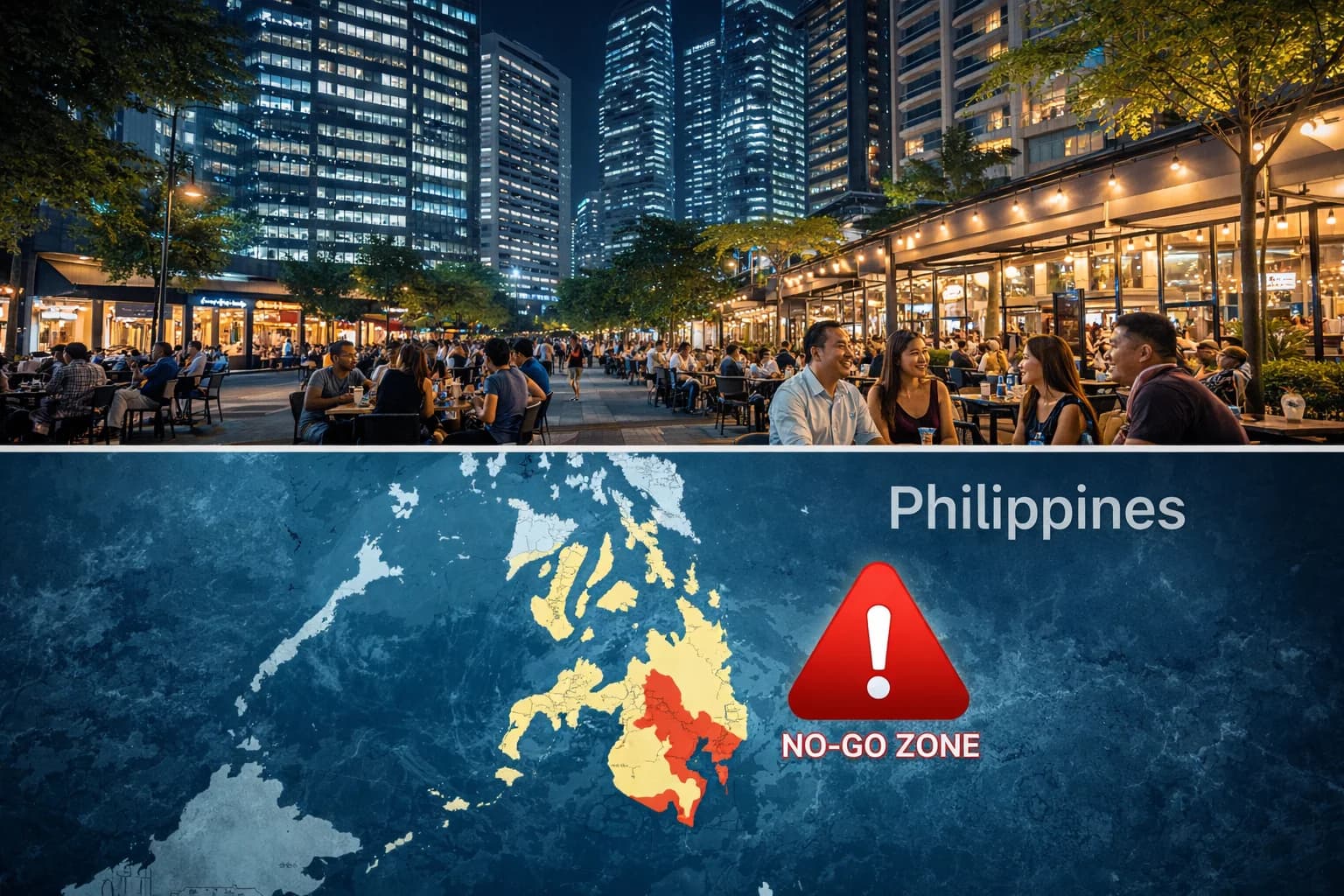
Safety in the Philippines in 2026: The Unfiltered Expat Guide
If you talk about your upcoming vacation in the Philippines to your family in Europe or America, chances are someone will immediately bring up "kidnappings, terrorists, or Manila gangs." It's the stubborn cliché of post-Cold War Southeast Asia.
As expats living here for years, we are going to set the record straight. Yes, there are no-go zones. Yes, you have to be careful in Manila. But no, the Philippines is not a dangerous country for tourists. According to international statistics, it is even safer than many major Western capitals.
Here is the detailed and updated breakdown for 2026.
---
1. The "Red Zones" Map: Where NOT To Go
This is the only truly non-negotiable point regarding local safety. Most Foreign Affairs Ministries (US State Department, UK FCDO, France) classify certain regions as "Red" (Strongly advised against, risk of kidnapping and terrorism).
Mindanao Island (The South)
The deep south of the Philippines is home to historical geopolitical conflicts (Islamic insurgencies, local clan conflicts).
* What is forbidden: The southern provinces of Mindanao (Sulu, Tawi-Tawi, Basilan, Zamboanga, the Marawi region, and Cotabato). Western tourists are strongly advised to stay away. There is no tourist infrastructure there anyway.
* What is allowed (and popular) in Mindanao: The north of the island (Siargao, Camiguin) or the East (Davao City, one of the safest cities in Asia) present NO risk related to terrorism. Siargao is even the surfing capital of the country, packed with foreigners!
The Extreme South of Palawan (Balabac?)
Some embassies classify the south of Palawan (Balabac) as an orange/red zone due to its maritime proximity to Malaysia and past pirate incursions in the 2000s.
* Today, Balabac is increasingly visited for its magnificent virgin beaches. Dozens of agencies organize boat safaris there in complete peace of mind. It hasn't been a "real" red zone for 15 years.
---
2. The Real Danger in Manila: Pickpockets and Scams
If you travel to Bohol, Siquijor, or El Nido, the level of violent crime against foreigners is practically zero. The only time you should raise your awareness level is during your stay in the sprawling metropolis of Manila (Metro Manila: 14 million inhabitants).
Pickpockets and "Atlag" (Snatch Theft)
Just like in Paris, Barcelona, or Rome, highly dense areas (Malate, Ermita, Divisoria markets) attract petty thieves.
* The Rule: Never hold your brand-new iPhone 15 ostensibly in your hand while walking near the road. Motorbike snatch thefts do happen. Put it in a fanny pack or crossbody bag. Never put your wallet in the back pocket of your jeans in the elevated metro (LRT/MRT).
* The Bullet Myth (Tanim-Bala): You may have read on older blogs that airport police used to slip rifle bullets into tourists' luggage to extort them. This 2015 scandal was completely eradicated by former President Duterte. Forget about it.
---
3. Solo Female Travelers
The Philippines is often perceived as one of the hardest and most patriarchal destinations in Asia. Is it true?
Surprisingly, it's the exact opposite. The Philippines has had two female presidents, and the local society is highly matriarchal in practice.
It is one of the safest destinations in the world for solo female travelers.
The Attitude of Filipinos
Filipinos are deeply courteous and hospitable (due to Hispanic and Asian cultural influences). Street catcalls are very rare in the islands.
* Bar Harassment: If a slightly tipsy man becomes persistent in a backpacker bar, a firm "No, Kuya" (No, big brother) usually stops all interaction without any violence.
* The Real Trap for Everyone: Dogs! This is the true little "danger" for solo hikers at night. Stray dogs defend their territory after midnight. Always take a tricycle at night, even to travel just 500 meters.
---
4. The Natural Threat (The Most Frequent)
If you really want to be afraid of something in the Philippines in 2026, don't fear the locals. Mother Nature is the one in charge.
1. Typhoons (Habagat): From July to November, typhoons regularly sweep the north and east of the country, cutting off electricity for days and canceling all maritime ferries. Always follow the local weather app (PAGASA). Never go on a boat trip if the coast guard raises a warning flag.
2. Centipedes and Sandflies (Niknik): Never walk barefoot at night in tall grass, and spray yourself with local repellent (OFF!) on the isolated beaches of Palawan. Sandfly bites itch excruciatingly for up to 3 weeks.
---
Conclusion: Use Common Sense, No Paranoia!
The Philippines is a joyful, noisy country where everybody smiles and where the kidnapping of westerners in the streets belongs to the urban legends of the 90s.
You can walk around in the evening in casual clothes, with your camera around your neck in any tourist spot (Cebu City, Bohol, Coron...) without feeling an ounce of discomfort.
The only vital thing to stay "safe" is to have organized your ferries and buses in advance so you don't wander around at 4:00 AM in a sketchy bus terminal!
Plan and book
Useful services to complete your Philippines trip
Always compare the final price and conditions before booking. These are the steps that most often delay a departure.
Compare flights
Search routes and fares to Manila, Cebu or Clark.
Search flights →Book accommodation
Choose a flexible option and keep proof of your arrival address.
View accommodation →Book activities
Compare tours, visits and experiences in Manila, Cebu and Palawan.
Browse activities →Arrange a transfer
Pre-book a ride between the airport and your accommodation.
Compare transfers →Compare a complete trip
An alternative for comparing flights, hotels and transport in one place.
Open Trip.com →Check travel insurance
Review medical coverage and exclusions before departure.
Get a quote →Install an eSIM
Prepare your mobile connection before landing in the Philippines.
View data plans →Prepare your payments
Compare exchange rates and fees before payments or transfers.
Explore Wise →Prepare onward proof
Verifiable reservation solution when your return itinerary is not fixed.
View solution →