Suitcase or Backpack? The Ultimate Philippines Checklist
Is traveling with a large hardshell suitcase suicidal in the Philippines? Our suitcase vs. backpack comparison and the exact checklist of what to (and NOT to) pack for your vacation.
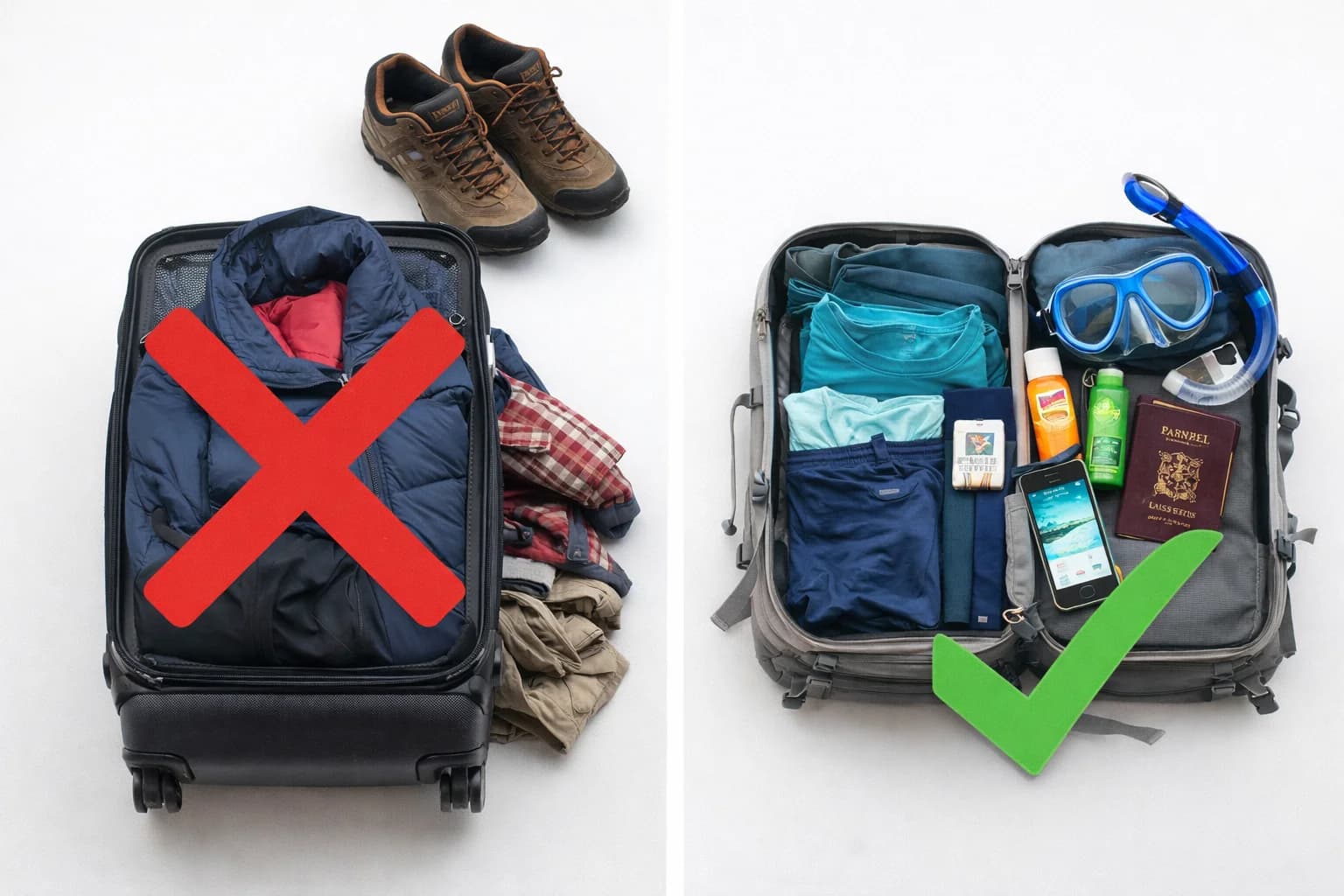
The Daily Debate: Should You Dare Bring a Rolling Suitcase to the Archipelago?
One of the most debated questions by our clients: "I'm hesitating between a 60L backpack or a large Samsonite rolling suitcase for my 3-week stay in the Philippines?"
In many well-paved Asian countries, perfect sidewalks would encourage you to choose the small cabin suitcase. But in the Philippines... you'll be slaloming between bangkas (outrigger boats on the sand), tricycles with no trunks, and crowded ferries.
Here is the ultimate guide to avoiding carrying your anxieties on your back, and our ruthless 2026 checklist.
---
1. The Match: Backpack VS Hardshell Suitcase
The Backpack (Ideally front-loading: like an Osprey Farpoint)
It's the undisputed champion for a vacation in the Philippines (one large checked bag + one small dry bag for the day).
* Its advantages:
1. You can hop on a scooter (habal-habal) from the terminal to the hotel without any problems, placing the small bag on the gas tank and the large one on your back.
2. You can walk through knee-deep water to board a tiny boat at the El Nido port: it won't be dragged through the sand or submerged.
3. Tricycle drivers won't charge you a "cargo" surcharge.
The Hardshell Rolling Suitcase
Let's be clear: it is awful on 80% of the Philippine islands.
* Why is it hell?:
1. Rolling suitcases DO NOT roll in the sand of Siargao, Malapascua, or Bantayan beaches.
2. They smash against your shins on the stairs of Ro-Ro ferries.
3. There are (often) no uniform paved sidewalks to roll it elegantly; it will get stuck on every bump in the alleyway.
4. To fit into a tricycle, it will take up the precious space of a 3rd rear passenger.
* When is a suitcase useful? Exclusively for a luxurious or business trip, like a "Single Resort" stay with no intensive island-hopping (e.g., land in Cebu, take a private taxi straight to Shangri-La Resort Mactan, and return to the airport).
---
2. Warning: Domestic Flight Baggage Policies
If you travel with Cebu Pacific or AirSWIFT (for Coron / El Nido).
* The standard checked baggage you pay for as an add-on is 20 KG (and sometimes only 10 kg).
* Double-check your allowance when booking! Excess weight at the airport will cost you an astronomical price (sometimes more expensive than your ticket itself).
Local tip:* Cebu Pacific staff are ruthless with the luggage scales. Don't buy heavy bottles or canned goods as gifts. Travel LIGHT. Wash your kilos of laundry once you arrive for less than $2.
---
3. The Ultimate Bag Checklist (2026)
The weather never drops below 26°C (79°F), and humidity hovers around 85%. Pack NOTHING thick.
MUST-HAVE Items (The Essentials):
1. A small Dry Bag (10L or 20L) (Ocean Pack). You can buy one locally for $5 or bring it. It's vital to keep your iPhone, wallet, and power bank safe during boat hops.
2. Aqua Shoes: So you don't cut your feet on corals during your snorkeling sessions, and especially to avoid getting pierced by a sea urchin.
3. Secret money belt: Less essential than in Barcelona, but very useful in Manila (Airport terminal or Metro).
4. Universal Power Adapter: In the Philippines, the outlets are the same as in the US! Flat parallel prongs (110v/220v). Keep it in your carry-on luggage.
5. Compact waterproof windbreaker (Rain jacket or Goretex): If you come from June to November (the monsoon season), the 4:00 PM downpour will soak the road. Do NOT pack a sweater!
6. REEF SAFE Sunscreen: Please! Respect the exceptional seabeds of Apo Island and Palawan by avoiding chemical filters.
The First Aid Kit:
Don't bring a hospital suitcase. Buy your mosquito repellents locally (`OFF! Overtime`), as European/US ones are useless against Asian mosquitoes.
Most importantly, pack good anti-diarrhea meds (Imodium, Pepto-Bismol) for the bacterial shock (the famous local Traveler's Diarrhea), as well as a disinfectant (Betadine) and waterproof "Aquagel" bandages that stay on in seawater after a coral cut!
---
The local philosophy: You'll see that you spend 90% of your time in a light T-shirt, shorts, and flip-flops! The neighborhood "Laundry" only costs $1.50 per washed and ironed kilo in 24h. Why break your back carrying a mountain of unnecessary clothes?
👉 Check out our planner to optimize your routes without struggling with suitcases
🎒 The Debate: Rolling Suitcase vs Backpack?
This is THE question all expats and tourists ask themselves before their flight.
The Backpack (max 50L):
Best for: Isolated islands, tours with a lot of transfers (rural tricycles, bangkas that dock directly on the sand in the water).
Our opinion: In the Philippines, sidewalks are often non-existent or cluttered. A quality backpack is the best investment you can make.
The Rolling Suitcase:
Best for: Static stays in a resort, Manila, Cebu City, Boracay (since the recent renovations).
Our opinion: Only take it if you plan to stay in premium locations and move exclusively by Grab taxi/private van from the airport to the hotel. On the docks of small ferries, its wheels will not survive the rainy season and the mud.
❓ FAQ : Luggage Preparation
Can we buy clothes and gear directly on site?
Yes, absolutely. If you come to Manila or Cebu City, gigantic malls like SM Mall of Asia, Ayala, or Glorietta will provide you with absolutely all the gear you need (UPF 50+ rash guards, masks, quality snorkels, OFF! mosquito repellent).
How many kilos am I allowed for domestic flights with Cebu Pacific / AirAsia?
On smaller routes (propeller ATR flights to Siargao or Coron, for example), the checked baggage weight limits are very strict: often 10kg or 15kg maximum, because the landing strips are short (e.g., El Nido Lio Airport, Del Carmen). Never travel with a 25kg suitcase if you are taking domestic flights to small islands.
Plan and book
Useful services to complete your Philippines trip
Always compare the final price and conditions before booking. These are the steps that most often delay a departure.
Compare flights
Search routes and fares to Manila, Cebu or Clark.
Search flights →Book accommodation
Choose a flexible option and keep proof of your arrival address.
View accommodation →Book activities
Compare tours, visits and experiences in Manila, Cebu and Palawan.
Browse activities →Arrange a transfer
Pre-book a ride between the airport and your accommodation.
Compare transfers →Compare a complete trip
An alternative for comparing flights, hotels and transport in one place.
Open Trip.com →Check travel insurance
Review medical coverage and exclusions before departure.
Get a quote →Install an eSIM
Prepare your mobile connection before landing in the Philippines.
View data plans →Prepare your payments
Compare exchange rates and fees before payments or transfers.
Explore Wise →Prepare onward proof
Verifiable reservation solution when your return itinerary is not fixed.
View solution →