Tricycles, Jeepneys, and Grab: Getting Around the Philippines (Prices and Scams)
The definitive guide to local transport in the Philippines in 2026. How to negotiate a tricycle, take a Jeepney without getting lost, and use Grab safely.
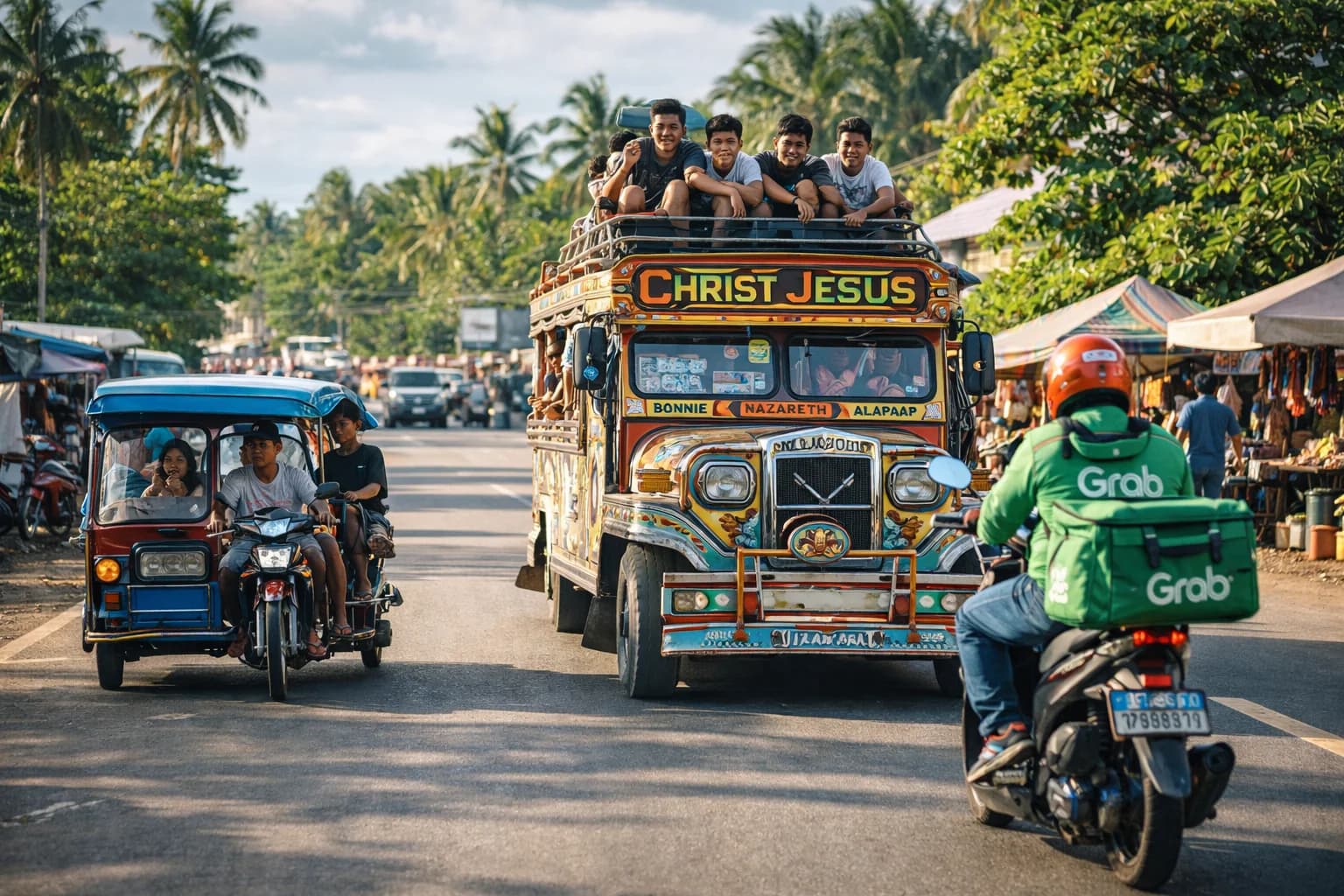
Local Transport in the Philippines: Mastering Tricycles and Jeepneys in 2026
Forget Tokyo's orderly subway or Singapore's air-conditioned buses. In the Philippines, local public transport is a colorful, noisy, and often very "roots" adventure. If you don't want to pay triple the "Filipino" price for every trip, you have to master its codes.
Between the legendary Jeepney inherited from the American army, the motorized tricycle, and modern ride-hailing apps (Grab), here is the complete traveler's survival manual for 2026. No more getting fleeced by the first driver at the port exit!
---
1. The Jeepney: The Soul of the Philippines (15 Pesos)
It's the national symbol. These former American World War II military vehicles have been lengthened, painted in garish colors, and covered with religious icons or pop slogans to become urban buses (locally called "Jeeps").
How does it work?
1. No fixed stops: A Jeepney stops (almost) anywhere, anytime. Stand on the side of the road and raise your arm.
2. Where is it going? This is the hardest part! The destination is usually roughly painted on the windshield or on the side in yellow letters. (e.g., "Capitol - SM City - Mabolo"). Not sure? Shout your destination from the outside through the back door before getting in.
3. Paying (Pasahe): You get in through the back and sit on the two long face-to-face benches, shoulder to shoulder. The legal minimum base fare (the first few kilometers) is 13 to 15 Pesos (barely 25 USD cents).
4. The miracle of change: You say "Bayad po" ("Here is my payment") while handing over your 20 or 50 Peso bill (never give 500 or 1000!). The passengers between you and the driver will pass the money from hand to hand to the front, and your exact change will make its way back to you the same way. No one ever steals a dime.
5. To get off: You knock two small taps on the metal roof (or an iron bar with a coin) and shout "Lugar lang po" (Please stop here).
Warning: "Modern Jeepneys" (which look like real small white or blue air-conditioned minibuses) are gradually replacing the old smoking models. They cost about 5 to 10 Pesos more, but the experience remains identical.
---
2. The Tricycle (Philippine Tuk-Tuk): The Art of Negotiation
The Tricycle is a motorcycle welded to a covered cabin (the "sidecar") that can carry (in theory) 3 people... (in practice, we've seen 8 people plus a 50 kg sack of rice!).
It replaces taxis in 90% of provincial towns (Coron, El Nido, Bohol, Siquijor...).
The 2 types of pricing:
* Regular Fare (Shared pricing): The tricycle travels on a main road. It stops, you get in with strangers. The fare is around 15 to 30 PHP per person depending on distance.
* Special Ride (Private ride): You charter the tricycle for yourself (like a taxi). This is what drivers offer to 99% of foreign tourists. The price suddenly jumps from 30 PHP to 100, 200, or even 300 PHP per ride!
How to avoid the tourist scam (The "Kano Price")?
1. Move away from tourist hubs: NEVER take the first tricycle parked right outside your hotel, the seaport, or the mall. They have a "tourist" monopoly. Walk 50 meters to hail a moving one on the main road. The price will drop instantly.
2. The law of the "Special": Always ask "How much to [Destination]?". If they reply 150 PHP for a 2 km ride, say no, answer "Special, 50 pesos ok?", and walk away. 90% of the time, they will call you back.
3. At night: After 9:00 PM or 10:00 PM, tricycle fares double. This is legal and normal.
Classic Example in El Nido: The trip "Town Center -> Lio Beach" (20 min) should not exceed 300 PHP for the whole vehicle (Special Ride). Many try to sell it for 500 PHP. Don't hesitate to negotiate, but always keep smiling (a Smile is the best negotiation weapon).
---
3. Grab and JoyRide (Ride-Hailing): Safety and Comfort
Are you in Manila (or anywhere in Metro Manila) or Cebu City? NEVER raise your hand to hail a classic white street taxi. The risk of the "broken" meter scam (the famous "Contract Price Sir") at night with you locked in the back is far too real.
The absolute solution is called Grab (the undisputed king of Southeast Asia after acquiring Uber).
Why Grab is indispensable:
* The price is fixed in advance on your app.
* The route is tracked by GPS (ideal for safety).
* You can link your international bank card so you don't have to handle cash. (Cash is also accepted).
* Average Manila Price: 200 to 450 PHP depending on traffic. During rush hour (between 5:00 PM and 8:00 PM), the algorithms double the prices; it's better to know this.
The Alternative: JoyRide or Angkas (Motorcycle-Taxi)
In Manila's gruesome traffic (capable of blocking a car for 1.5 hours to go 5 km), the App-based Motorcycle-Taxi is the expats' secret.
* You order a motorcycle, and you are provided with a helmet (along with a hygienic hair net).
* You zigzag between fully stopped lines of traffic.
* It's twice as fast and often 30% cheaper than a car. Absolutely download these apps (JoyRide or Angkas) before coming to Cebu or Manila.
---
What You Should Never Forget
Transport in the Philippines is "physical." You sweat (a lot), breathe in dust in open tricycles, and spend a lot of time compressed in Jeepneys (especially if you are over 6ft/1m80 tall!).
But it's also the best way to exchange smiles with Filipino schoolchildren, practice 2 or 3 words of Tagalog (`Salamat po` = Thank you), and plunge into the heart of the true local "way of life."
Never let the stress of moving around ruin your domestic connections again! Plan all your port and airport connections for your personalized roadbook using our tool.
Plan and book
Useful services to complete your Philippines trip
Always compare the final price and conditions before booking. These are the steps that most often delay a departure.
Compare flights
Search routes and fares to Manila, Cebu or Clark.
Search flights →Book accommodation
Choose a flexible option and keep proof of your arrival address.
View accommodation →Book activities
Compare tours, visits and experiences in Manila, Cebu and Palawan.
Browse activities →Arrange a transfer
Pre-book a ride between the airport and your accommodation.
Compare transfers →Compare a complete trip
An alternative for comparing flights, hotels and transport in one place.
Open Trip.com →Check travel insurance
Review medical coverage and exclusions before departure.
Get a quote →Install an eSIM
Prepare your mobile connection before landing in the Philippines.
View data plans →Prepare your payments
Compare exchange rates and fees before payments or transfers.
Explore Wise →Prepare onward proof
Verifiable reservation solution when your return itinerary is not fixed.
View solution →